Stone Ambassador benchtops: colours, ranges, and what to expect from quote to install
Stone Ambassador benchtops: colours, ranges, and what to expect from quote to install
Stone Ambassador is a popular engineered stone choice for kitchens, laundries and vanities.
This guide covers the range, popular colours, what affects price, and what to expect from quote to install across South East Queensland.
Who this is for (South East Queensland only)
We’re SEQ Stone (Burleigh Heads). We supply, cut, deliver and install stone benchtops across South East Queensland, including the Gold Coast, Brisbane, and nearby areas. (Sunshine Coast and surrounds may be possible depending on access and scheduling.)
Most enquiries we see fall into a few common SEQ project types:
- New builds where you need to lock in colour, thickness, and edge profile before handover.
- Kitchen renos where timing needs to line up with cabinet install, plumbers and sparkies.
- Investment property refreshes where you want a hard-wearing surface and a straightforward install.
Two questions come up most:
- You’ve found a colour (often Blanco Bliss or Ottoman Grey) and want to know if it will work with your cabinetry and lighting.
- You’re comparing Lavistone, Vicostone, Vadara (and similar) and want realistic price drivers, lead times, and what affects the finished look.
At a glance
- Ranges: Essential Range (streamlined) or the broader Stone Ambassador range (more variety). Availability can change, so confirm current slabs.
- Popular colours: Blanco Bliss and Ottoman Grey.
- Thickness: most jobs are 20mm. You can get a 40mm look with a mitred edge.
- Edges: common options include square, pencil-round, and shark nose.
- Popular upgrades: waterfall ends, upstands, and full-height splashbacks.
- Cut-outs: sinks (undermount/topmount), taps, cooktops, and other appliance openings.
- Typical timing: many SEQ jobs are around 1–2 weeks from measure to install, depending on colour availability, complexity, and site readiness.
What Stone Ambassador is
Stone Ambassador is an engineered stone surface (often called a quartz surface) used mainly for interior benchtops.
People choose it because it offers:
- Consistent colour across multiple pieces
- Modern patterns, including marble-style looks
- Good everyday durability with normal care
It’s commonly used for:
- kitchen benchtops and islands
- bathroom vanity tops
- laundry benchtops
- selected feature areas
Browse current options here: Stone Ambassador range.
Stone Ambassador ranges (including Essential)
Stone Ambassador is offered in different ranges. Some are designed to keep selection simple and pricing more predictable.
That’s useful when you’re working to a build schedule or trying to keep a reno moving.
Stone Ambassador Essential Range
The Essential Range is the practical, popular end of the selection.
It suits you if you want:
- a clean colour that works with most cabinetry
- fewer decisions
- a straightforward path from selection to install
How Essential differs from the broader range:
- Patterns and finishes: Essential focuses on core, high-demand looks. The wider range typically includes more variation and may include different finishes.
- Budget and planning: Essential is often chosen for simple kitchen renos, laundries, and investment refreshes.
- Lead times: when colours are in steady supply, Essential can be easier to schedule. Some colours in the wider range can be more variable.
If you have a handover date or trades booked, mention it early.
In SEQ, the most common delays are slab availability and site readiness (cabinetry, panels, appliance specs), not the cutting itself.
Ready for pricing? Send your plan and suburb and we’ll confirm availability, edge detail and timing. Request a quote.
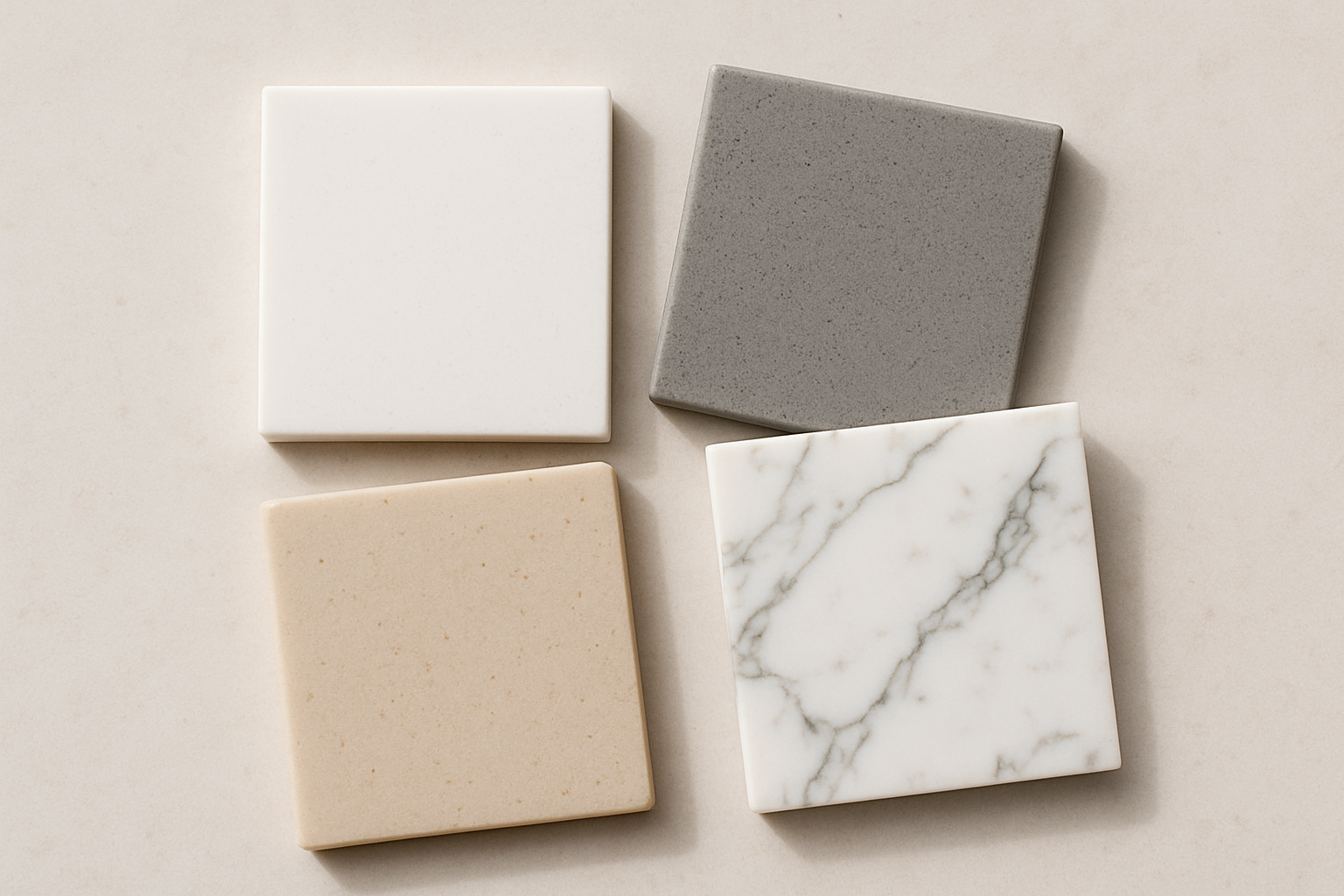
Stone Ambassador colours: how to choose
Pick your colour based on cabinetry, lighting and splashback.
Online images help you shortlist, but they don’t always show undertones accurately.
If you can, view samples under lighting close to what you’ll have at home. Warm vs cool LEDs can change how a colour reads.
Match undertones to cabinetry
- Warm cabinets (timber, cream, warm white): often suit warm whites, beige tones and softer greys.
- Cool cabinets (crisp white, charcoal, blue-grey): often suit cleaner whites and cooler greys.
If you’re unsure, bring a cabinet door sample.
If cabinetry isn’t installed yet, bring a flooring sample or paint swatch to set the “temperature” of the space.
Choose your “movement” level
- Low movement: clean and even. Good if you want minimal visual texture.
- Medium movement: gentle speckle/clouding. Often forgiving day to day.
- High movement / veining: statement look. Join placement and slab orientation matter more.
On long runs and islands, higher movement usually needs more planning around joins and what you’ll see from key viewing angles.
Choose your finish (polished or matte)
- Polished: reflects light and can make a kitchen feel brighter.
- Matte: softer look. It can show marks differently depending on colour and use, especially around the sink and prep zones.
If you cook often, think about where water sits, where oils splash, and how you clean day to day.
Popular colours we’re asked about
- Blanco Bliss: clean white look for modern kitchens.
- Ottoman Grey: versatile mid-grey that suits light or dark cabinetry.
If you found a colour online, send the name and a screenshot.
We’ll confirm availability and suggest close alternatives if that specific colour is limited.
Blanco Bliss vs Ottoman Grey (quick notes)
Blanco Bliss
- Undertone: typically a clean, bright white.
- Lighting: cool LEDs make it look crisper; warm LEDs soften it.
- Cabinet pairings: crisp white for a minimal look, or timber for contrast.
- Everyday look: brighter whites can show water spotting and daily “traffic” more than mid-tones, especially near sinks and dish racks.
Ottoman Grey
- Undertone: balanced grey that can read warmer or cooler depending on nearby finishes.
- Lighting: warm LEDs make it feel cosier; cool LEDs can look more steely.
- Cabinet pairings: works with white, light grey, charcoal, and timber.
- Everyday look: mid-greys often hide fingerprints and water spotting better than bright whites.
20mm vs 40mm: what changes
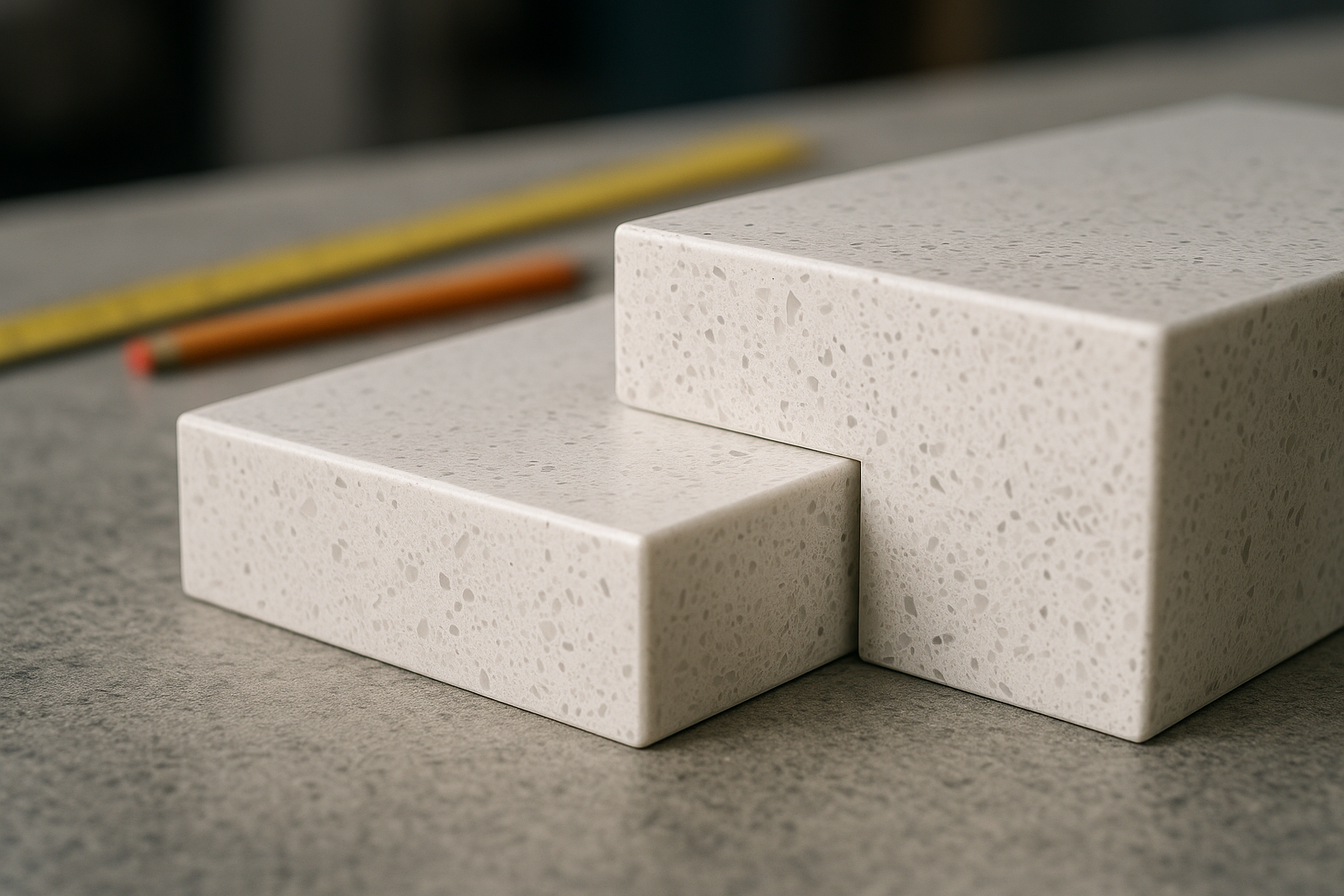
Most kitchens use 20mm.
If you want a thicker look, you can often get it without using full 40mm everywhere.
20mm benchtops
- clean and modern
- suits most cabinetry
- often best value for larger layouts
40mm benchtops
- thicker, heavier look
- common on feature islands
- suits classic or Hamptons-style kitchens
The common option: 40mm look (mitred edge)
A mitred edge uses 20mm stone to create a thicker-looking front edge.
We’ll confirm what suits your layout once we know:
- spans and support
- any waterfall ends
- seating overhangs and number of stools
- sink and appliance cut-outs
If you’re planning a larger overhang, flag it early.
Support and clearances are much easier to sort before cabinetry is signed off.
What affects price (so the quote makes sense)
The slab matters, but fabrication, detailing, and install conditions can change the price a lot.
Pricing usually depends on:
- Size and layout: longer runs and bigger islands use more material.
- Cut-outs: sinks (undermount/topmount), cooktops, tap holes, pop-up power.
- Edges: square/pencil-round/shark nose, or a mitred edge for a 40mm look.
- Splashbacks: 100mm upstands vs full-height stone splashbacks.
- Waterfall ends: more material, more joins, more finishing time.
- Access: stairs, tight hallways, crane needs, parking, lift bookings, and carry distance.
Two practical points that prevent surprises:
- Joins can be unavoidable. Long runs, large islands, or access limits may require multiple pieces. Good join placement and tidy finishing matter more than trying to avoid joins at all costs.
- The same colour can vary by batch. If you’re doing kitchen plus laundry and vanities, ordering together (where possible) helps keep the look consistent.
For a fast, accurate quote, send:
- your plan (PDF is fine)
- photos of the space
- suburb and preferred timing
- preferred colour (or 2–3 options)
Send details here: Request a quote.
From quote to install: our SEQ process
The smoothest installs happen when the site is ready and key selections are locked in early.
1) Confirm selections and do quick checks
We confirm the surface, thickness, edge profile, splashback approach (if any), and any waterfall details.
It also helps to confirm early:
- sink type (undermount vs topmount)
- cooktop model
- accessories like dish drainer/rack cut-ins
2) Templating (final measure)
Templating happens after cabinetry is installed and secure.
Common site issues that delay templating:
- cabinets not level or not fully fixed
- end panels not fitted
- appliance positions not confirmed
- fillers/returns still changing (common in renos)
If you’re mid-reno, plans often change.
The key is to do final measure only once everything that affects the benchtop footprint is locked in.
3) Approvals
We confirm layout, joins, cut-outs and edges before fabrication.
If you’ve chosen a veined look, we’ll also talk about orientation and which faces are most visible.
4) Fabrication
We cut, polish, complete mitres (if selected), and do openings for sinks, cooktops and other items.
5) Delivery and installation
We deliver, place, join and finish the stone, then clean down and talk you through care.
Typical lead times in SEQ
Lead times vary by colour and workload.
After final measure, fabrication is often around 3–5 working days, with install booked soon after.
Many SEQ projects end up around 1–2 weeks from measure to install. Timing depends on slab availability, cut-outs, edge details (like mitres), access, and production scheduling.
To lock in a timeline, book templating as soon as cabinetry is confirmed and appliances are selected. Book a quote or measure.
What to expect on install day
Most installs are completed in one visit.
Larger or more complex jobs (big islands, multiple pieces, waterfall ends, full-height splashbacks) can take longer.
On the day, expect:
- Time on site: often a few hours, depending on access, joins and finishing.
- Noise and some dust: we keep on-site cutting to what’s necessary.
- Access needs: clear walkways, protected floors if required, and a clear bench area for safe handling.
- Appliances and plumbing: your plumber/electrician/cabinetmaker may need to disconnect and reconnect services.
- When you can use it: we’ll advise when the bench and sink area can be used, depending on join and finishing work.
For apartments and townhouses, check building rules early (lift bookings, loading zones, work hours, protective coverings).
These rules can affect delivery windows and how many people are required on site.
Gold Coast installs: coastal considerations
If you’re searching for stone benchtops on the Gold Coast, the product choices are similar across SEQ.
What changes is often the logistics.
Common Gold Coast considerations:
- Transport and access: tight stairwells, long carry paths, basement carparks, or restricted loading zones.
- Site readiness: cabinetry must be fixed and level, end panels fitted, and the work area clear.
- Timeline expectations: lift bookings and limited delivery hours can add coordination time.
If you’re on the northern Gold Coast or closer to Brisbane, quoting is the same.
Just include access notes upfront so handling and scheduling are planned properly.
Care and day-to-day use
Engineered stone is durable, but it isn’t indestructible.
Good habits:
- wipe spills early (especially oil, coffee, wine, curry, beetroot)
- use a cutting board
- use trivets under hot pots and trays
- clean with pH-neutral cleaner or warm soapy water
In coastal areas, wipe off grit or sand before sliding items around.
Fine particles can act like sandpaper over time.
Comparing Stone Ambassador with Lavistone, Vicostone and Vadara
When comparing brands, use the same checklist each time:
- Look: shortlist 2–3 colours you’d be happy to live with.
- Finish: polished vs matte.
- Availability: what can be supplied within your schedule.
- Detailing: edges, cut-outs, and splashback plans.
- Install outcome: join placement and fit matter as much as the slab.
We supply multiple brands, so we can help you compare similar looks across ranges.
Helpful pages:
Note for “Stone Ambassador Adelaide” searches
People sometimes search nationally (for example, “Stone Ambassador Adelaide”).
SEQ Stone services South East Queensland only.
If you’re outside SEQ (including Adelaide), you’re welcome to contact us for general product guidance.
For supply and install, you’ll need a local fabricator.
Get a Stone Ambassador quote (Gold Coast or Brisbane)
To price your job quickly, send:
- cabinet plan or dimensions
- photos of the space
- sink and cooktop model numbers (if chosen)
- preferred Stone Ambassador colour (or shortlist)
- any access constraints (stairs, tight entries, apartment lift bookings)
Get started: Request a quote.
For local examples and available colours, visit the Gallery and Stone Range pages.
Quick FAQs
Is Stone Ambassador engineered stone?
Yes. Stone Ambassador is supplied as an engineered stone surface (often referred to as quartz-based engineered stone).
Is Stone Ambassador stone “quartz”?
In everyday terms, yes.
If you need exact specs for a specific colour (including any current compliance requirements), ask us and we’ll confirm what applies to the slabs being supplied.
20mm vs 40mm: should I choose full 40mm or a 40mm-look mitred edge?
Most kitchens use 20mm.
If you want the thicker look, a mitred edge is a common option, especially on island panels and feature ends.
Full 40mm can suit some styles, but it can change weight, handling and detailing.
Can you do waterfall ends?
Yes. We fabricate and install waterfall ends and can advise on join placement and vein direction (where applicable).
What sink cut-outs do you do?
We do undermount and topmount sink cut-outs, plus tap holes and accessory cut-outs.
Share your sink model number and we’ll confirm the best approach.
Do you do cooktop cut-outs?
Yes. We cut to your appliance specs, including required clearances and corner details.
How long from measure to install in SEQ?
After templating, many SEQ jobs are around 1–2 weeks from measure to install.
Timing depends on slab availability, cut-outs, edge details (like mitres), site access, and production scheduling.
Related reading: Click Here