WK Stone benchtops: what it is, where it fits, and how to choose the right finish
WK Stone benchtops: what it is, where it fits, and how to choose the right finish
If you’re searching WK Stone, you’re usually close to locking in a benchtop. The fastest way to avoid delays is to confirm your colour, finish, thickness, edge profile and cut-outs before templating.
We supply, cut and install stone benchtops across the Gold Coast, Brisbane and South East Queensland. This guide explains what WK Stone is, where it suits, and what we need for an accurate quote.
Quick specs (so your quote is accurate)
These details most often change the installed price and lead time.
- Finish: polished / matte / honed (availability varies by colour)
- Thickness: 20mm or 40mm look (often a mitred build-up)
- Edge profile: square (softened), arris (softened square), pencil round, mitred (for 40mm look)
- Cut-outs: sink, cooktop, tap holes, drainer grooves
- Extras: waterfall ends, slab splashbacks, island overhang support
If you share finish + thickness + edge profile upfront, we can price like-for-like and reduce back-and-forth.
What is WK Stone?
WK Stone is a range of engineered stone (quartz) slabs. In Australian homes, it’s commonly used for:
- Kitchen benchtops (including islands)
- Waterfall ends
- Bathroom vanity tops
- Laundry benchtops
- Slab splashbacks (when the design and heat clearances allow)
Quartz benchtops are made from manufactured slabs, not natural stone. People choose quartz for its consistent look, wide colour range (including marble-look styles), and practical day-to-day performance.
A note on variation
Even with engineered stone, the look can vary between brands and between batches of the same colour. That’s normal.
If you have a WK Stone colour name, screenshot, or a display-home photo, send it through. Just note that phone photos can shift whites warmer or cooler depending on lighting.
Where WK Stone fits in the market (AU brand comparisons)
WK Stone is often compared with Quantum Quartz, Essastone, Smartstone, Caesarstone, Lithostone, YDL Stone and Stone Ambassador ranges.
For many customers, WK Stone suits when you want:
- A practical range for everyday kitchens and renovations
- Popular whites, greys and marble-look styles (range-dependent)
- A straightforward quartz option without overcomplicating the selection
In most projects, the “best” choice is the slab that:
- matches your cabinetry and flooring undertones
- has the finish you want
- is available in Australia in time for install
Where to view WK Stone colours in SEQ
If you’re choosing between whites, greys and marble-look designs, a bigger sample (or slab viewing) makes decisions easier. It matters most in open-plan homes, where the kitchen is visible from multiple areas.
- Start with our WK Stone range online.
- Once you shortlist a few colours, we’ll suggest the best way to view samples across the Gold Coast–Brisbane corridor.
Availability can change quickly. If you have a handover date or cabinet install booked, confirm what’s in stock (or inbound) before you sign off.
Where WK Stone suits best in a home
WK Stone quartz is commonly used for:
- Kitchen benchtops (including islands and waterfall ends)
- Bathroom vanities
- Laundry benchtops
- Slab splashbacks (where the design allows)
In SEQ, kitchens often see heavy daily use (indoor–outdoor living, kids, entertaining). That can affect the best choice of finish, edge detail and overhang design.
Kitchens: islands, sizing and overhangs
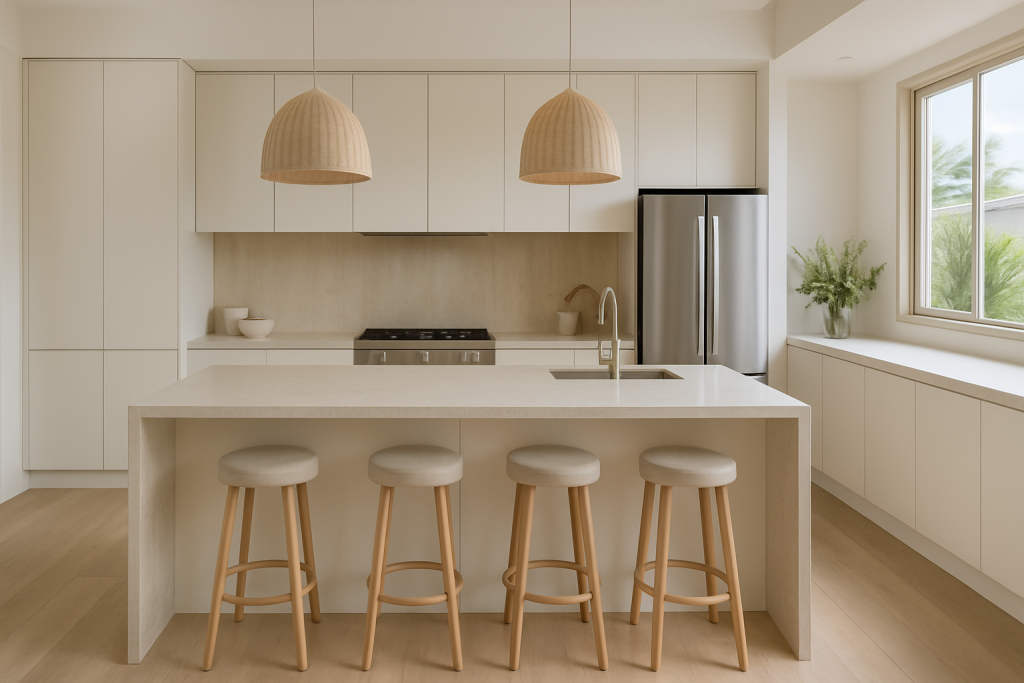
Island benches are common across the Gold Coast and Brisbane. A few practical details affect both the look and the engineering.
- Stool overhangs: confirm the overhang depth early. Longer overhangs may need extra support (depends on cabinetry, thickness and layout).
- Traffic flow: islands sit in walkways, so softened corners and practical edge profiles matter.
- Seams on long runs: very long islands may need joins. It’s better to plan joins early.
Joins and vein direction are most noticeable on large islands, especially in marble-look colours. If you want a statement island, tell us before templating so the slab layout can be planned.
Waterfall ends (mitres, joins and vein alignment)
A waterfall end runs the benchtop down the side to the floor. It looks clean, but it uses more material and makes joins and veining more visible.
- Mitred waterfall panels: often used for a thicker look. Join lines can be more noticeable on some colours/finishes.
- Vein wrap: if you want veining to flow from top to panel, raise it early so we can plan slab orientation.
- Bookmatching: possible on some patterns, but needs planning and may require extra slab allocation.
Not every pattern can “wrap” perfectly. The best result usually comes from a layout that looks intentional, rather than forcing a match.
Bathrooms (moisture, ventilation and day-to-day care)
Quartz is popular in bathrooms because it wipes down easily and generally resists everyday staining.
- Don’t let water pool around taps and basins (especially near silicone lines).
- Use mild cleaners and rinse residue.
- Good ventilation helps reduce mould on sealant and joints over time.
Laundries (chemicals and cleaner caution)
Laundries see stronger chemicals than kitchens.
- Don’t let bleach, dye or degreasers sit on the surface.
- Avoid abrasive powders and scourers.
- Mid-tone colours or light patterns can hide daily marks better than flat dark colours under bright lighting.
Splashbacks (suitability, limits and compliance considerations)
Slab splashbacks can look excellent when you want a continuous look from benchtop to wall. They’re not the best option for every cooktop wall.
- Cooktop heat zones: clearances and heat exposure matter.
- Appliance specs come first: always follow the cooktop/rangehood manufacturer instructions.
- Power points and wall straightness: slab splashbacks need accurate set-out and good wall conditions.
If a slab splashback isn’t suitable for your layout, we’ll flag it early to avoid rework later.
Marble-look veining: what to know before you sign off
Marble-look quartz is a common reason people cross-shop WK Stone with other ranges. These steps help avoid surprises.
- Expect batch variation: veining and background tone can change.
- View the slab if the pattern matters: small samples don’t show full movement.
- Plan joins and vein direction: it changes how islands and long runs look.
- Ask about bookmatching: great for waterfalls and feature panels, but needs planning.
If you’re doing a statement island or waterfall, tell us early so we can plan the slab layout properly.
Practical performance: what quartz is good at (and where to be careful)
Quartz is made for day-to-day living, but it isn’t “no maintenance”. A few simple habits protect the finish.
Porosity and stain resistance
Engineered quartz is generally low-porosity, so it resists everyday staining better than many natural stones.
- Wipe spills sooner (especially coffee, red wine, turmeric and oils).
- Use a chopping board to protect knives and reduce surface wear.
For coastal homes, sand and grit are a big factor. Fine grit can act like sandpaper under plates and appliances, so a quick wipe before food prep helps.
Heat resistance (general guidance)
Quartz handles normal kitchen heat, but it’s not a hotplate.
- Use trivets and heat pads.
- Don’t place hot pans straight from the cooktop or oven onto the benchtop.
Rapid temperature change (heat shock) can damage the surface or resin.
Scratch and chip resistance
Quartz is hard-wearing, but it isn’t scratch-proof or chip-proof.
Chips are most common at:
- edges and corners (especially on walkways)
- sink and cooktop cut-outs (narrow sections)
If durability is your priority, arris or pencil round edges are usually more forgiving than a sharp square edge.
Cleaning (what works in real homes)
Most homes do best with simple cleaning:
- warm water + mild detergent
- non-abrasive cloth or sponge
- avoid scourers and abrasive powders
Quartz resists etching better than natural marble, but harsh chemicals and abrasive cleaning can still change the surface over time.
How to choose the right finish (polished vs matte vs honed)
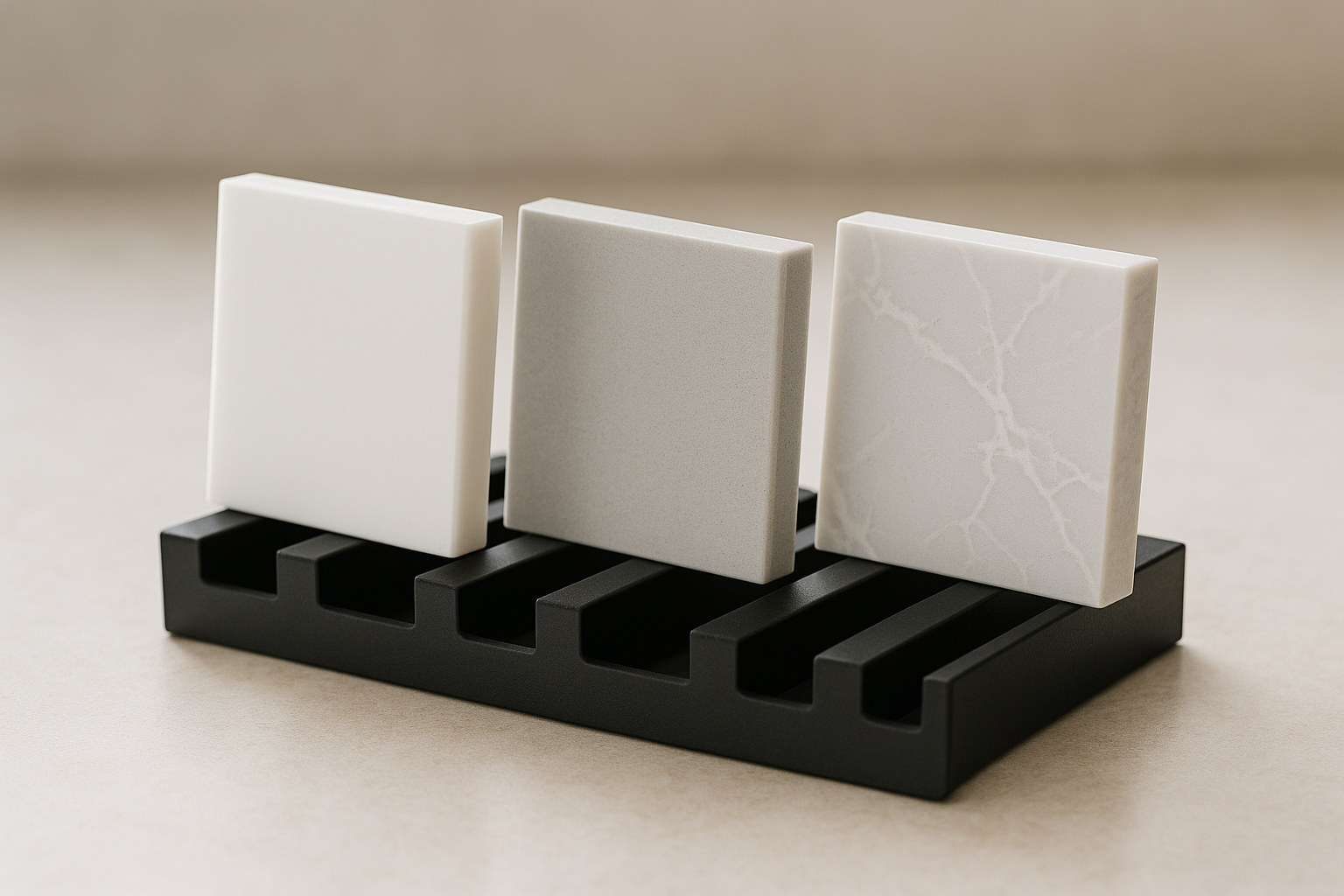
Compare tones and finishes in your lighting before you lock in the colour.
Finish affects both the look and how the benchtop behaves day-to-day.
- Polished: higher shine, brighter under lights, usually easiest to wipe clean. Can show smears under some lighting.
- Matte: softer look, lower sheen, calmer under downlights. Can show fingerprints/oils on some darker colours.
- Honed: smooth, low sheen between polished and matte. Not available in every colour.
What to consider
- Fingerprints and smears: more noticeable on dark colours and in raking light.
- Lighting: warm vs cool LEDs can shift whites (cream vs crisp).
- Lifestyle: polished can be quicker to wipe; matte can disguise some everyday marks.
- Style: polished reads brighter; matte/honed can feel more muted and architectural.
If you’re deciding between matte and polished, try to view both under lighting similar to your home.
How to choose thickness and edge detail (20mm vs 40mm)
Thickness: 20mm vs 40mm look
- 20mm: clean, modern look and suits most kitchens.
- 40mm look: usually a mitred build-up using 20mm stone to look thicker.
A 40mm look can increase slab usage and labour, especially on islands and waterfall ends.
Key points:
- Support: thicker-looking edges don’t automatically mean better support. Cabinetry and bracing matter.
- Transitions: if you’re tying into an existing surface, thickness changes can affect alignment.
- Budget: mitres and waterfalls typically add fabrication time.
Edge profiles (when to choose each)
Common options in SEQ:
- Square (softened): minimal and modern. A slight ease improves comfort and chip resistance.
- Arris: keeps the square look while reducing chipping risk.
- Pencil round: very practical for busy kitchens and family homes.
- Mitred edge: used for the 40mm look and some waterfall detailing.
Edge choice affects labour, corner durability, and how the island feels when people lean or gather.
Common project pitfalls (and how to avoid them)
Most issues are avoidable with early confirmation and clear set-out.
- Seam placement: plan joins early so they land in the least noticeable, most practical spots.
- Overhang support: confirm stool overhangs and support needs before templating.
- Sink cut-outs: undermount sinks need exact specs. Narrow rails around sinks can be weak if not designed well.
- Cooktop clearances: follow appliance instructions, especially if considering a slab splashback.
- Drainer grooves: confirm early. They change the look and rely on correct fall.
- Templating timing: template after cabinets are installed, levelled and secured.
Stone templating is usually one of the last steps before fabrication. If cabinetry is still being adjusted, it’s often better to wait than risk rework.
Lead times and what affects installed price in SEQ
Lead time and price depend on more than the slab.
Common factors:
- stone availability (in stock vs inbound)
- access (apartments, stairs, tight entries, loading rules)
- cut-outs (sink/cooktop, undermount, tap holes)
- thickness (20mm vs 40mm mitred build-up)
- edge profile (square vs arris/pencil round vs mitred)
- island size and overhang support
- waterfall ends (extra material and more visible joins)
- splashbacks (wall prep, power points, heat-zone limits)
Most jobs follow: measure/template → fabrication → install.
Templating usually happens once cabinets are installed and secured, and once sinks and cooktops are confirmed. If you’re working to a schedule, align stone dates with your cabinet maker and plumbing/electrical rough-in.
WK Stone vs other brands (common comparisons in Australia)
The best way to compare ranges is to check:
- appearance (undertone and pattern scale)
- finish options
- availability and lead time
- installed price band
Two colours that look similar online can read very differently next to your cabinetry and flooring.
WK Stone vs Quantum Quartz
Quantum Quartz is one of the most common comparisons.
Compare:
- undertone (warm white vs cool white)
- movement (quiet vs bold veining)
- finish availability (polished vs matte/honed)
- lead time (what’s available locally)
If you like a clean white, Alpine White (Quantum Quartz) is a common reference point. If that’s your benchmark, we can show similar whites across WK Stone and other ranges, then narrow it down based on availability and installed cost.
WK Stone vs Essastone (also searched as “essa stone”)
Essastone is another established quartz brand. The decision usually comes down to the exact slab look and what’s available when you need it.
- Matte/honed can look softer under downlights.
- Polished often looks brighter.
- If a colour isn’t available locally, lead time can affect your schedule.
See: Essastone®.
WK Stone vs Caesarstone
Caesarstone is widely known, so it’s normal to cross-shop.
Focus on:
- colour match in your lighting
- finish options (varies by colour)
- price band (some colours cost more installed)
- availability (in stock matters more than brand name)
See: Caesarstone®.
WK Stone vs Smartstone
Smartstone comes up often for marble-look patterns.
If you can, bring a cabinet door sample (or a clear photo). We’ll help match undertones, veining style and finish, especially for open-plan homes.
What about Lithostone, Stone Ambassador, YDL Stone?
You may also see Lithostone, Stone Ambassador (including Essential range), or YDL Stone.
The process is the same:
- confirm the exact colour and finish
- confirm Australian availability
- confirm the layout (joins, cut-outs, thickness, waterfalls)
- confirm who measures and installs (and when)
If you share your shortlist, we’ll compare like-for-like.
Colour selection: light vs dark, solid vs veined
These simple rules help you choose confidently.
- Light colours: brighten kitchens and hide dust well, but can show stains if spills are left too long.
- Dark colours: look dramatic, but show fingerprints, salt residue and fine scratches more.
- Veined/marble-look: great as a feature. Plan vein direction and joins early.
- Solid/quiet patterns: often make joins less noticeable and suit busy spaces.
For coastal homes, mid-tones or light patterns can be more forgiving day-to-day.
To match the benchtop well, compare it against:
- cabinetry (white can be warm or cool)
- flooring (timber tones shift how whites read)
- splashback and grout
- wall paint
If you’re using Alpine White (Quantum Quartz) as your reference, tell us. It helps us match undertone quickly.
Quartz or natural stone: which should you choose?
Choose quartz if you want a consistent look, lots of colour options, and straightforward care. Choose natural stone if you want a one-of-a-kind slab and you’re comfortable with more variation (and sometimes more care).
If you’re comparing quartz and natural stone, we can help you weigh up look, maintenance tolerance and budget.
Silica safety and engineered stone regulations (Australia — general info)
Australia’s approach to silica safety and engineered stone has changed in recent years, including tighter rules on handling and fabrication.
For homeowners, the practical takeaway is simple: choose a fabricator/installer that uses appropriate dust controls and follows current Australian requirements.
This is general information only, not legal advice. For current guidance, check Australian Government and state workplace safety updates.
What SEQ Stone can do for WK Stone projects
We’re a Gold Coast stone masonry team. We supply, cut and install quartz and other stone benchtops across the Gold Coast, Brisbane and South East Queensland.
Our service includes:
- supply (WK Stone and other ranges)
- site measure and templating
- fabrication and cutting
- delivery
- installation
See real installs in our Gallery.
What to send us for an accurate quote
For accurate pricing and a clear timeline, send:
- kitchen plan (PDF is fine)
- photo of the space (or new cabinetry, if installed)
- preferred range/colour (WK Stone or alternatives)
- finish: polished / matte / honed
- thickness: 20mm or 40mm look
- edge profile: square / arris / pencil round / mitred
- sink and cooktop details (model numbers help)
- any waterfall ends, island overhangs, or slab splashbacks
If you’re renovating, mention whether you’re keeping existing flooring or splashback lines. Those constraints can affect thickness choices and splashback set-out.
Next step: confirm your WK Stone colour and get a firm figure
If you’re ready to proceed, we’ll confirm availability, check measure details, and give you a firm installed figure.
- View the WK Stone range
- Browse our Gallery
- Send plans via Get a Quote
If you have a target install week, tell us early. We’ll confirm what’s realistic once we’ve checked stock and measured your job.