Stone benchtops on the Gold Coast: a practical guide to materials, colours, finishes, costs and timelines
Stone benchtops on the Gold Coast: a practical guide to materials, colours, finishes, costs and timelines
Stone benchtops that suit Gold Coast homes come down to three things: the right material, the right finish, and good planning before anything is cut.
Gold Coast conditions matter. Salt air, sand, sunscreen and grime can mean you wipe surfaces more often. Bright coastal daylight also makes undertones, joins and marks easier to see than in a showroom.
We’re SEQ Stone (also searched as SEQ Stone / seq stone). We fabricate and install stone benchtops from Burleigh Heads across the Gold Coast and nearby areas.
If you want pricing, get a quote from SEQ Stone. Send your plan plus a couple of daylight photos and any appliance model numbers you know. It helps us flag join positions, cut-out limits and access issues early.
What “stone benchtops” usually means
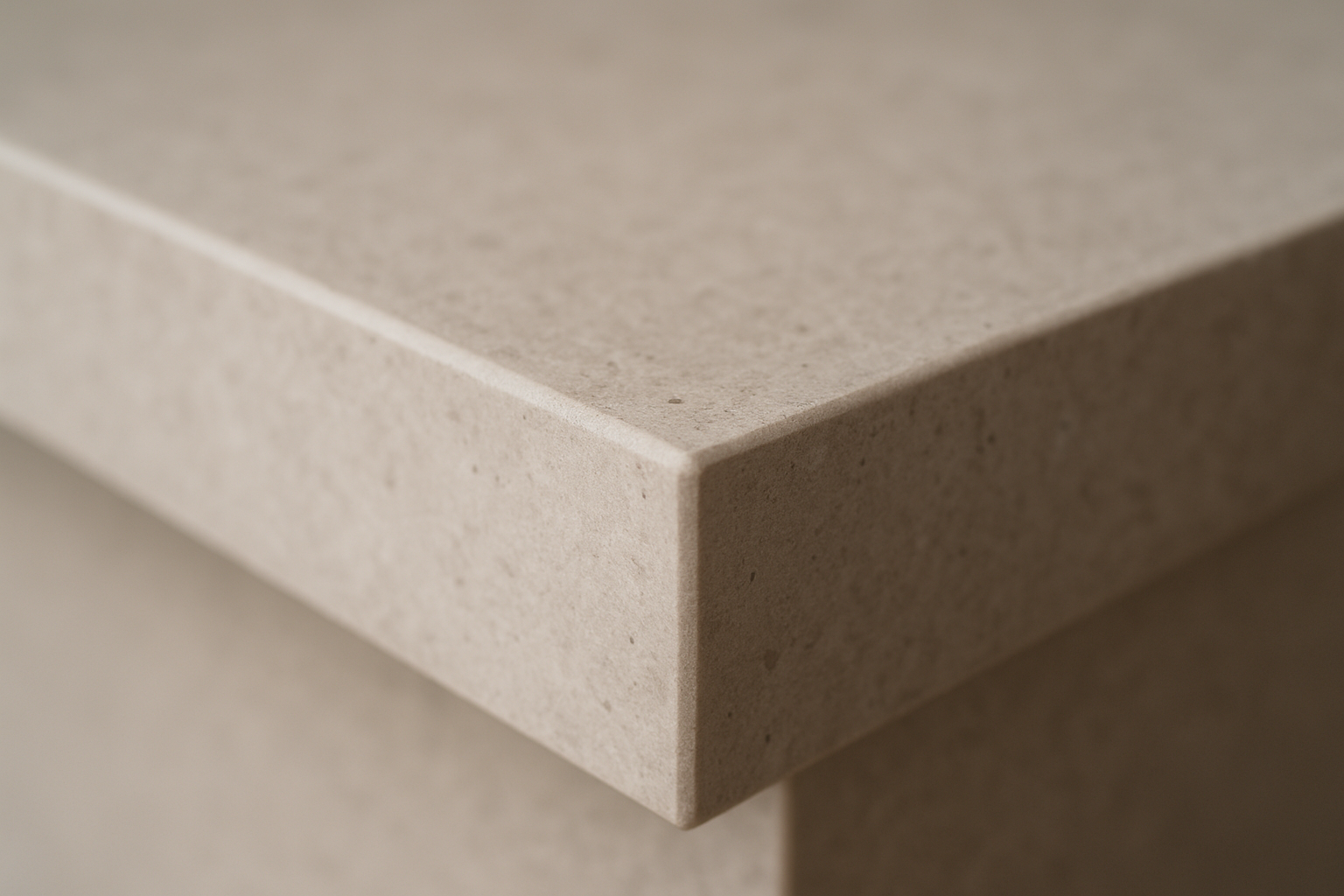
Most people mean one of these surfaces:
- Engineered stone: manufactured slab (stone aggregate + binders). Consistent colour and pattern.
- Natural stone: quarried slab. Unique variation (granite, marble, quartzite).
- Porcelain: fired, ultra-compact surface. Known for heat and UV performance.
The best choice depends on where it’s going (kitchen, bathroom, laundry, alfresco), how you cook, and how much maintenance you want.
Step 1: Choose the right material
Engineered stone (popular for most homes)
Engineered stone is consistent and predictable across long runs. It’s often the simplest option for busy households.
Why people choose it
- Consistent colour and pattern (great for long runs and big islands)
- Big style range (clean whites through to bold veining)
- Easy day-to-day cleaning (mild soap and water)
Common Gold Coast brands include Caesarstone®, Smartstone, Essastone®, plus ranges people ask about such as Lithostone, YDL Stone, WK Stone, and Stone Ambassador (including the Stone Ambassador Essential Range).
Helpful pages:
Where it suits
- Kitchen: ideal for most households
- Bathroom/laundry: tidy look and easy care
- Alfresco/outdoor: confirm UV suitability (some products can change in harsh sun)
Gold Coast tip: strong daylight (especially western afternoon light) can exaggerate undertones. If you’re choosing a white, check whether it leans cool (blue/grey) or warm (cream/beige).
Availability has changed due to silica safety rules. What matters is what’s compliant and available when you’re ready to order.
Porcelain benchtops (strong UV and heat performance)
Porcelain is a popular choice on the Gold Coast for modern homes and indoor–outdoor layouts. It’s also one of the safer bets in bright, sun-exposed areas.
Where porcelain suits
- Kitchen: low-fuss cleaning and a crisp look
- Bathroom/laundry: strong stain resistance for everyday products
- Alfresco/outdoor: excellent UV stability for sunny areas
Maintenance and performance
- UV: typically excellent
- Heat: excellent, but avoid thermal shock (for example, icy items straight onto a surface that’s been baking in sun)
- Etching: not an issue like it is with marble
- Everyday care: mild detergent and water; avoid harsh abrasives
Planning watch-outs
- Edge options can be more limited depending on thickness and product
- Impacts can chip edges (corners and sink rails are common risk areas)
- Joins, overhangs and cut-outs need careful planning
Always confirm the specific product is rated for your level of sun and heat, especially with dark colours and north-facing spaces.
Natural stone (granite, marble, quartzite)
Natural stone gives you unique movement and character. The trade-off is that maintenance and performance vary a lot by slab.
Granite
- Best for: kitchens, laundries and many alfresco designs (slab dependent)
- Maintenance: usually benefits from sealing
- Performance: typically durable; less prone to etching than marble
- Note: porosity varies, so sealing and cleaning habits matter
Marble
- Best for: bathrooms/vanities, feature islands, lower-use areas
- Maintenance: sealing helps with staining, but does not stop etching
- Performance: can etch from acids (lemon, vinegar, wine, some bathroom products)
- Note: marble changes over time, especially in busy kitchens
Etching isn’t dirt you can wipe off. It’s a chemical change to the surface.
Quartzite
- Best for: kitchens and statement islands
- Maintenance: usually benefits from sealing
- Performance: often very robust, but each slab behaves differently
- Note: choose from the actual slab where possible
Natural stone isn’t one maintenance level. Two similar-looking slabs can behave differently.
Step 2: Choose thickness (20mm vs 40mm)
Thickness affects cost, edge detail and the overall look.
20mm (clean and modern)
A common choice for:
- Standard kitchen runs
- Bathroom vanities
- Modern cabinetry
It’s usually the most cost-effective option.
40mm look (usually mitred)
A thicker profile suits:
- Larger islands
- More traditional cabinetry
- Kitchens that need more “visual weight”
Often, the 40mm look is a mitred edge (built-up edge). It looks thicker from the front without needing a true 40mm slab.
Tip: ask for a small arris (a lightly softened corner). It’s nicer to lean on and generally less chip-prone than a sharp edge.
Step 3: Pick a finish that suits real life
Finish changes how the benchtop looks and how often you notice marks. In bright Gold Coast homes, smears and fingerprints can show up more.
Polished
- Glossy and reflective
- Usually easiest to wipe down
- Can show streaks and “halo” marks in strong light (especially on dark colours)
Honed / matte
- Lower sheen and softer look
- Fingerprints can show (often more on darker colours)
- On some natural stones, etching can look more obvious
Leathered
- Tactile finish that adds depth to patterns
- Often hides fingerprints well
- Texture can hold fine residue if wipes are rushed (flour, coffee, spray-and-wipe film)
Textured (more pronounced)
- Strong character (often suits concrete-look styles)
- Can take a bit more effort to clean along the grain
Gold Coast tip: don’t choose a finish from a tiny sample under indoor lights only. View it in similar daylight to your kitchen.
Step 4: Choose colours for Gold Coast light
Gold Coast daylight is bright and often quite “white”. Colours can shift compared to online images or showroom lighting.
Common directions (and what to expect)
- White: bright and open; can read cooler in strong daylight
- Grey: flexible; check warm vs cool undertones
- Black: bold; shows dust, fingerprints, salt residue and water spots more
- Marble-look: veining can look higher-contrast in daylight
- Concrete-look: works well with matte or textured finishes
Colour selection tips
- Check undertones against cabinet doors and floors (warm with warm, cool with cool).
- View samples in your light (daylight and downlights at night).
- Sun can wash out cool whites and flatten subtle greys.
- If you hate wiping marks, consider a mid-tone and/or leathered/textured finish.
If you’re comparing Smartstone colours or Caesarstone colours, send:
- Cabinet door sample (or colour code)
- Splashback tile sample (if selected)
- A few daylight photos (wide + close-up)
For a starting point, see our full stone range.
Step 5: Fabrication details that change price and results
Two kitchens can be the same size and price differently. Differences usually come down to edges, joins, cut-outs, thickness and access.
Edge profiles
Your edge affects comfort, chip resistance and the overall style.
Common profiles:
- Square
- Arris (softened square)
- Bevel
- Pencil round
- Shark nose
- Mitred (often used for a 40mm look)
If you have kids, tight walkways, or you lean on the island a lot, an arris/softened edge is usually the most practical.
Seams and joints
Joins depend on slab size, layout, vein direction, strength needs and site access (stairs, narrow halls, apartments).
What to expect
- We place joins to be structurally sensible and as discreet as practical.
- Islands can sometimes be one piece, but not always.
- Join positions are confirmed at measure/template.
Where joins often go (when unavoidable)
- Near cooktop cut-outs to avoid weak, narrow sections
- At logical breaks like corners/L-shapes
- Away from main sightlines where possible
How to make joins less noticeable
- Choose colours/patterns that hide joins (some bold veining can highlight them)
- Plan vein direction early for marble-look and natural stone
- Keep expectations realistic: joins can be neat, but not always “invisible” in bright daylight
Cut-outs (sink, cooktop, tap holes) and strength
We’ll ask for your sink and cooktop model numbers.
Key points:
- Undermount sinks look premium but need tighter tolerances. The front rail needs careful planning for strength.
- Topmount/drop-in is usually simpler.
- Cooktop cut-outs need correct clearances and careful corner handling (stress points).
- Confirm tap holes early (filter taps, boiling/chilled taps, soap dispensers).
Cut-outs remove material. More cut-outs (or tighter spacing) increases the need for good reinforcement and join planning.
Waterfalls, overhangs, breakfast bars and drainer grooves
Waterfalls need:
- Reasonable floor levels (or a plan for gaps)
- Clear installation access
- Careful vein/pattern matching where relevant
For overhangs and breakfast bars, we’ll check spans and support requirements (including brackets and what’s under the top).
Drainer grooves can be added to some materials/finishes. They can change cost and cleaning effort, especially on textured finishes.
Splashbacks (full-height, tiled, or upstand)
You can choose tiled, glass or stone.
Stone splashback options
- Full-height stone: clean look, higher cost, more planning around power points
- Tiled: flexible and often cost-effective
- Stone upstand (50–100mm): practical middle ground with tile or paint above
If you want stone splashbacks, confirm heights, power points and finishes early. Late electrical changes can delay templating or create awkward cuts.
Costs: typical Gold Coast price ranges
Pricing varies by material, slab category and fabrication details. As a guide (supply, fabrication and install), many Gold Coast projects fall into these ranges:
- Engineered stone: $700–$1,200 per m²
- Porcelain: $900–$1,500+ per m²
- Natural stone (granite/marble/quartzite): $1,000–$2,000+ per m²
These are guide ranges only. Final pricing depends on your layout and selections.
What drives the final price
- Material type (engineered vs natural vs porcelain)
- Slab category/pattern (including premium veining)
- Thickness (20mm vs 40mm mitred look)
- Edge profile complexity
- Number of cut-outs and extras (drainer grooves, multiple tap holes)
- Waterfalls and panels
- Joins required (layout/access)
- Access and handling (stairs, apartments, tight entries)
- Splashback choice (tiled vs stone upstand vs full-height stone)
If you want an accurate quote, send a plan, appliance models and a couple of photos.
Step 6: Process and typical lead times
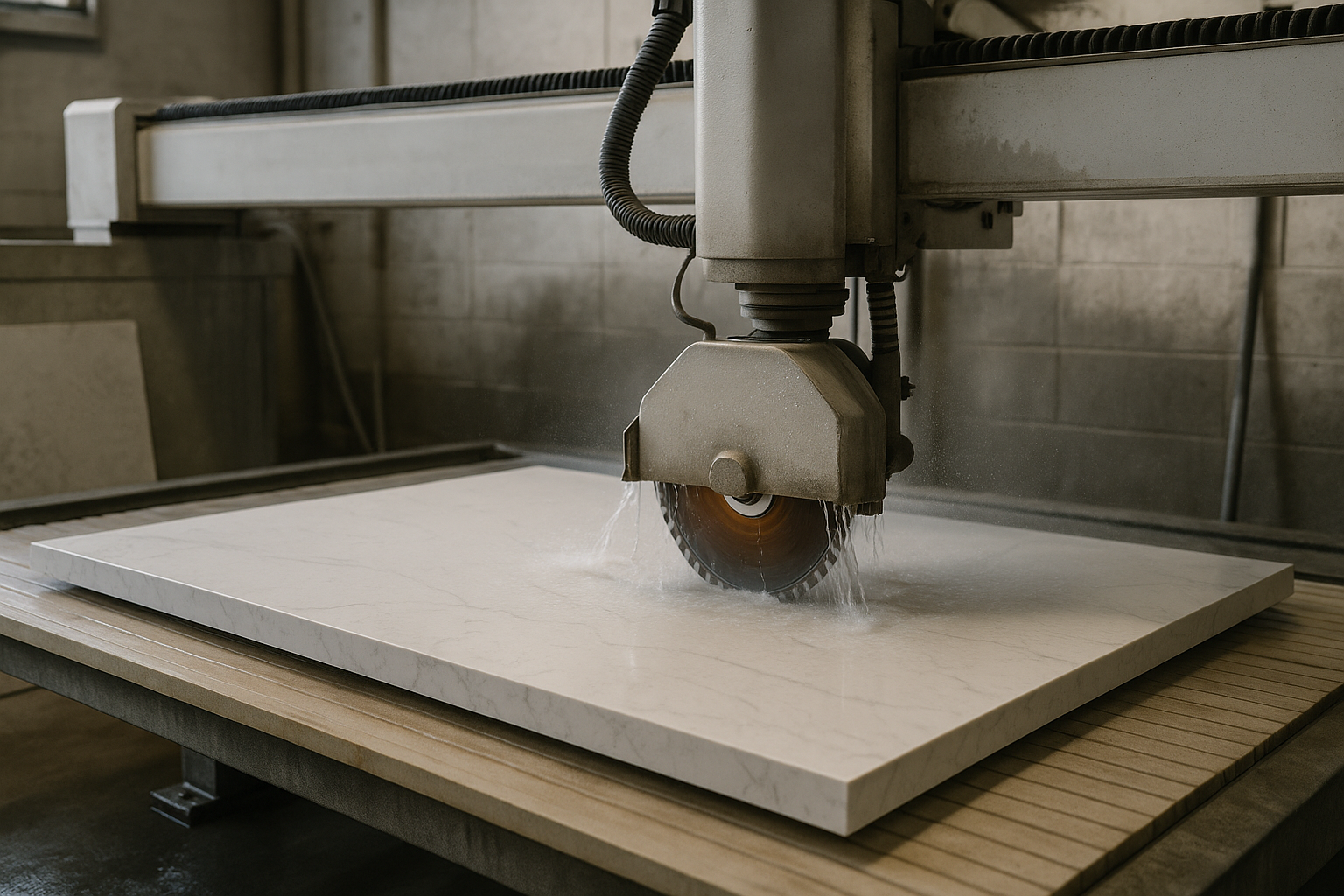
Most people searching “stone cutting near me” actually need a fabricator who can measure, cut to real cabinetry, and install.
Templating matters, especially in renovations where walls aren’t straight and cabinets aren’t perfectly level.
Our process (measure → template → fabricate → install)
- Send plans and photos
- Quote and confirm lead times
- Site measure/template (after cabinets are installed, levelled and secured)
- Fabrication in our workshop
- Delivery and installation
Typical lead times (and what delays them)
Many standard jobs are around 3–5 working days from final measure/template.
Lead times can extend if:
- Your slab isn’t in SEQ stock (special order/transfer)
- You need complex vein matching, multiple waterfalls, or lots of cut-outs
- Access is difficult (stairs, apartments, limited parking/loading)
- Cabinetry, plumbing or electrical isn’t ready
- Trade scheduling gets tight near handover
If you have a fixed handover date, choose your stone earlier. It gives everyone time to lock in sinks, power points and appliance specs.
Do you need custom stone cutting only?
If you already have stone and you’re searching for custom stone cutting near me, we can often help. For most kitchens and bathrooms, you’ll get a better result with template + cut + install handled by the same team.
Stone isn’t like timber you can trim later. Once it’s cut, it either fits the site or it doesn’t.
To avoid delays, send:
- Stone type and thickness
- Drawing with sizes
- Photos of the slab (both sides if possible)
- Cut-out templates or appliance specs
Quick checklist before you request a quote
Send these and we can price accurately:
- Plan or sketch with lengths
- Stone choice (or 2–3 options)
- 20mm or 40mm preference
- Sink and cooktop model numbers
- Notes on waterfalls, panels and splashbacks (full-height, tiled, or upstand)
- Suburb and site access notes
See examples of finishes and edge details
Photos help, but samples help more. If you can, view slabs or larger samples in person, then check them under your site lighting.
You can check out recent projects in our gallery.
Ready to price stone benchtops on the Gold Coast?
Send your plan, measurements and a couple of daylight photos. Tell us which brands you’re considering (for example Caesarstone®, Smartstone, Essastone®, Lithostone, WK Stone, Stone Ambassador, or YDL Stone).
Next step: Get a quote from SEQ Stone or request a callback.
FAQs
What do stone benchtops cost on the Gold Coast?
As a guide (supply, fabrication and install):
- Engineered stone: $700–$1,200 per m²
- Porcelain: $900–$1,500+ per m²
- Natural stone: $1,000–$2,000+ per m²
Final pricing depends on slab choice, thickness, edges, cut-outs, joins, waterfalls and site access.
How long does it take from measure/template to installation?
A common timeframe is around 3–5 working days from final measure/template for standard benchtops.
It can be longer for complex jobs, special-order slabs, or difficult access. It can also shift if cabinetry isn’t fully secured/levelled or if plumbing/electrical positions change late.
Is engineered stone banned in Australia?
Rules have changed due to silica safety concerns. What matters is what’s currently available and compliant when you’re ready to order.
We’ll confirm your options (and any constraints) when we quote.
Can I have a stone upstand instead of a full-height splashback?
Yes. A stone upstand (often 50–100mm) gives an easy-clean edge without the cost or look of full-height stone.
It also pairs well with tiled splashbacks.
How are seams placed on an island?
We avoid visible seams where we can. Sometimes a seam is needed due to slab size, pattern direction, strength requirements, or site access.
If a seam is required, we place it to be as discreet and practical as possible, and confirm it at measure/template.
Are porcelain benchtops good for bright, sun-filled Gold Coast kitchens?
Often, yes. Porcelain is known for UV stability and stain resistance, which suits bright kitchens and indoor–outdoor spaces.
The main considerations are edge detailing, joins and planning cut-outs properly.
Do natural stone benchtops need sealing?
Most natural stone (including granite, marble and quartzite) benefits from sealing to reduce staining.
Sealing doesn’t stop etching on acid-sensitive stones like marble.