Smartstone Melbourne: practical guidance before you choose your benchtop
Smartstone Melbourne: practical guidance before you choose your benchtop
Most people search Smartstone Melbourne to do two things: shortlist colours, and work out what to ask before committing.
This guide covers the decisions that change the finished result in a real Melbourne kitchen: colour and finish, thickness, joins, cut-outs, splashbacks, and install planning.
Use it as a shortlist and a checklist when you:
- Visit Smartstone slab displays or partner showrooms in Melbourne
- Compare quotes from local fabricators and installers
- Plan details with your cabinet maker or builder before templating
Quick link: Smartstone benchtops.
Smartstone in plain English
Smartstone is an engineered stone (often called a quartz benchtop). It’s made from natural quartz particles mixed with resins and pigments, then pressed and cured into slabs.
In everyday terms, that usually means:
- Non-porous surface that’s easier to clean and more stain resistant than many natural stones
- Consistent colour and pattern across long runs
- Durable for normal use (but not indestructible)
- Hygienic surface that suits day-to-day food prep
You may also see searches like smarstone or smart stone benchtops. Most people mean the same product category.
Start with how you use the kitchen (it changes the best colour)
The “best” Smartstone colour depends on how you live and how your kitchen is lit. A finish that looks great under showroom lights can look different in a Brunswick terrace, a Bayside extension, or a CBD apartment.
Consider these before you fall for a small sample:
- Busy household? Mid-tones and softer patterns usually hide crumbs, water spots and fingerprints better than flat bright whites.
- Lots of direct light? North-facing rooms can create glare on polished tops. Matte finishes often feel calmer.
- Cook a lot? Engineered stone doesn’t like sudden heat. Plan a heat-safe landing zone you’ll actually use.
This is the simplest way to avoid the “it looked different in the showroom” surprise.
Smartstone colours: how to shortlist like a pro
A colour chip is only a starting point. What matters is how the slab reads across long runs, corners, and next to finishes you won’t change easily (floors, tiles, timber tones).
A simple shortlist method
- Pick your base tone: bright white, warm off-white, or soft grey.
- Choose a pattern style: minimal, light veining, or bold veining.
- Match fixed finishes: floors, timber tone, cabinets, splashback, tapware.
- Decide on contrast: feature benchtop, or a quieter backdrop.
Bring your cabinet door and flooring samples if you can. It speeds up decisions and reduces mistakes.
Melbourne style cues that affect colour choice
Melbourne homes often mix old and new. Benchtop choices usually follow.
- Heritage homes (Victorian/Edwardian): warmer whites, gentle veining, softer profiles.
- Industrial looks (brick/steel/concrete-style): stronger greys, higher contrast, crisp edges.
- Modern builds/townhouses: simpler patterns and cleaner edges to suit handleless cabinetry.
If you’re also comparing Quantum Quartz Melbourne or Lithostone Melbourne, use the same method. Early on, base tone, finish and vein direction matter more than the brand name.
Want to rule things in or out faster? View our full stone range.
Carrara-style Smartstone: what to watch for
Carrara-style engineered stone is a common request in Melbourne. It gives a classic look with less upkeep than some natural stones.
The typical look is a light base with soft grey veining that reads “calm” from a distance.
The make-or-break detail: vein direction
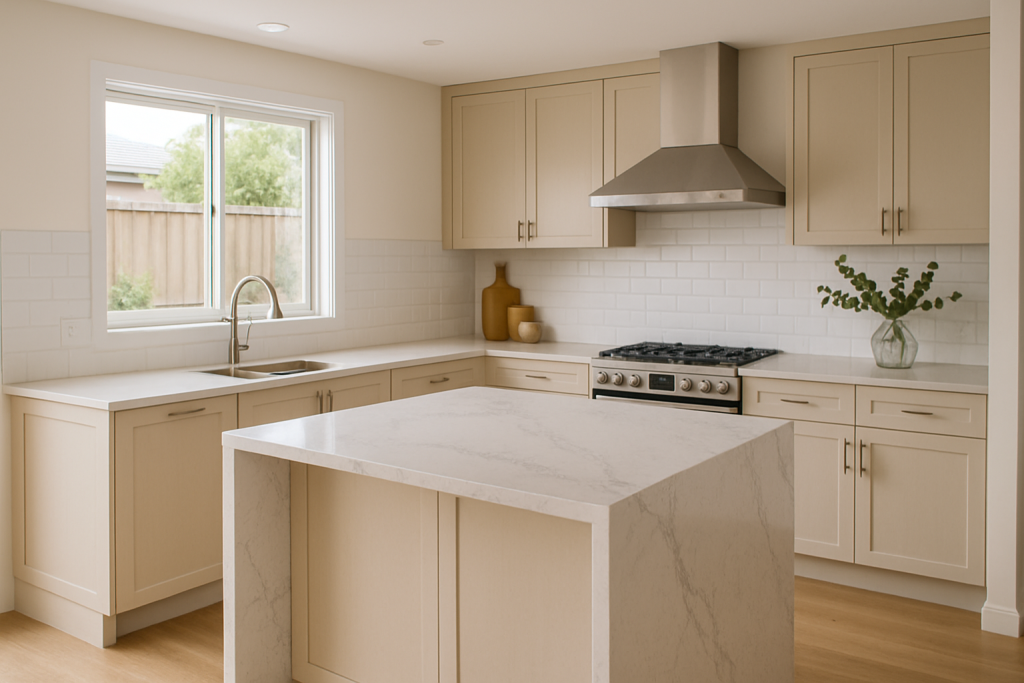
Vein direction can completely change the feel on islands, waterfall ends and long runs.
Ask your fabricator before cutting:
- Will the island be cut so veins run the full length?
- If there’s a waterfall end, can the pattern be aligned or bookmatched?
- Where will joins land, and will they be visible from key sight lines?
Better vein planning can increase cost. It can reduce slab yield and limit join placement, especially on larger kitchens.
20mm vs 40mm: choose the look, then confirm the build detail
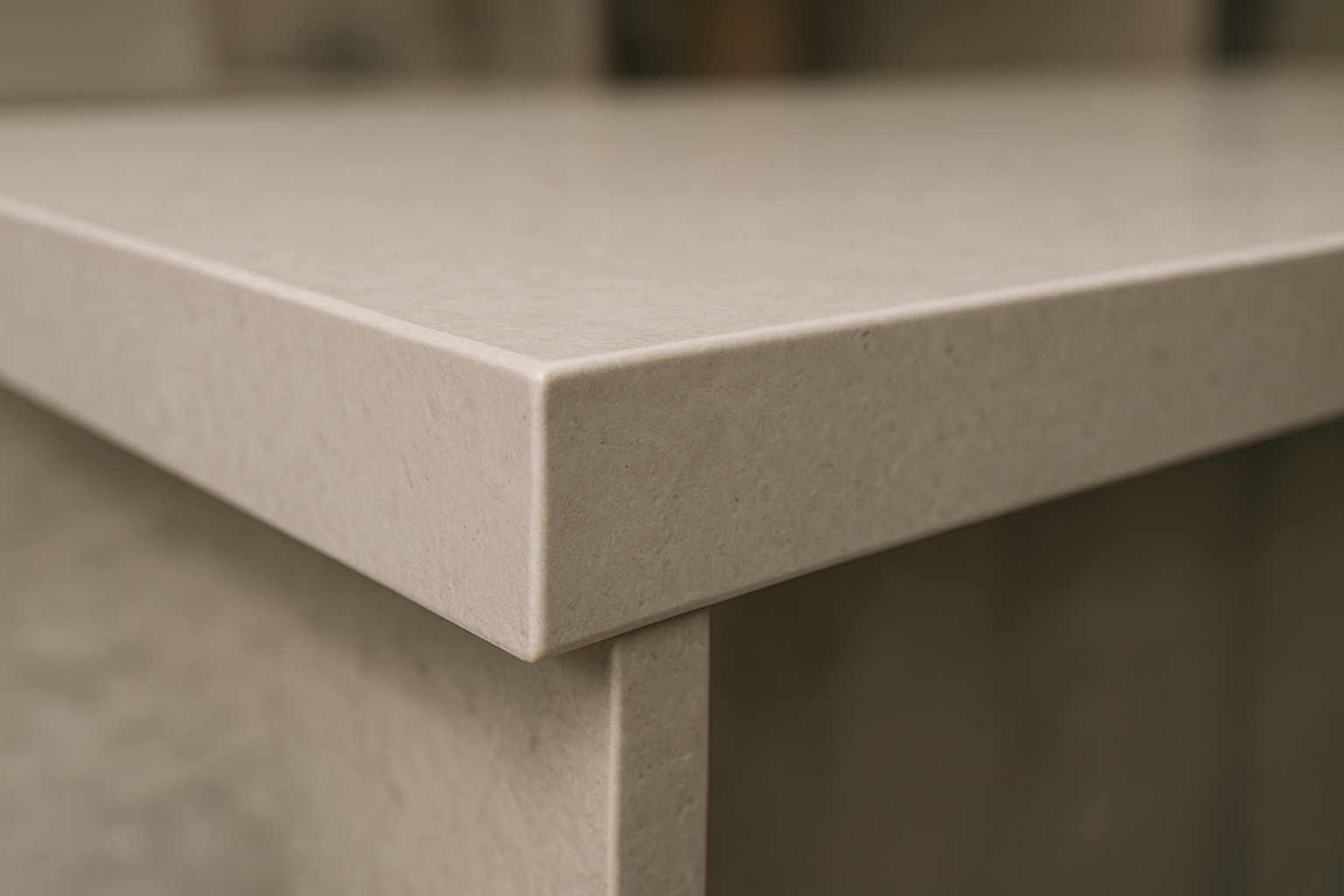
Edge detail matters as much as colour.
Most Smartstone benchtops are specified as 20mm. If you like a thicker look, you can usually get a 40mm appearance without using a full 40mm slab.
What’s common in Melbourne
- 20mm slab for strength and manageable weight
- Mitred edge to create a 40mm look
A 40mm look can suit:
- Islands that need a stronger feature edge
- Shaker-style kitchens (common in renovated heritage homes)
- Designs where cabinetry proportions suit a thicker top
Before you commit, consider the site:
- Older homes: floors and walls are often not level or square. A thicker edge can make minor twists more obvious.
- Apartments/tight access: stairs and lift sizes can limit piece size and change the install plan.
Joins, cut-outs and splashbacks (the details that change the result)
Two kitchens can choose the same Smartstone colour and still look very different. Joins, cut-outs and splashback decisions are usually why.
Join placement
- Long runs often need joins.
- Good join placement avoids main sight lines.
- Veined slabs need extra planning so joins don’t chop the pattern.
If you’re planning a large island, ask early where joins must go based on slab size, access, and carrying paths.
Sink and cooktop cut-outs
- Undermount sinks need clean internal edges and correct sealing.
- Cooktop cut-outs need correct clearances and tidy corner finishing.
Small “strips” of stone (for example behind a cooktop or between a sink and the front edge) can be vulnerable. A good fabricator will flag risk areas and suggest small layout changes to improve strength.
Splashbacks
Decide early. It affects power points, windows and measurements.
- Full-height stone splashback vs tiled splashback
- Window reveals and power point locations
- Upstands (small lip) vs none
If your build schedule is tight, lock this in before templating. Late changes can mean re-measuring or re-cutting.
“Smartstone technology”: what matters in a real kitchen
You’ll see marketing phrases like smart stone technology. What matters is how it performs in a kitchen that gets used.
Practical outcomes include:
- Dense, low-porosity surface for stain resistance and hygiene
- Consistent finishing so sheen looks even across joins
- More consistent colour across multiple pieces (island plus perimeter benches)
Use these real-world filters:
- Does the finish suit your lighting (morning vs afternoon, sunny vs overcast Melbourne days)?
- Does the pattern suit your kitchen size and island length?
- Can joins and cut-outs be planned cleanly?
- Are you realistic about heat and cutting habits?
Smartstone installation in Melbourne: what to ask before you sign
The slab matters, but the finished result depends on templating, fabrication, handling and installation.
Use the questions below to compare Melbourne fabricators and installers.
Lead times and sequencing
- What’s the lead time from template to install?
- What can delay it (appliance changes, slab availability, access bookings)?
- Do you template only after cabinets are fully installed? (They should.)
- How do you schedule around plumbing and electrical fit-off?
Site preparation (so install day runs smoothly)
- Do cabinets need to be fully fixed, level and braced before templating?
- What tolerances do you work to for out-of-square walls?
- How will you scribe to walls or allow for sealing gaps in older homes?
What’s included in the quote
- Is delivery, carry-in and installation included?
- Are there stairs, crane requirements, or apartment access fees?
- Who disconnects and reconnects sinks and cooktops?
- Are tap holes, soap dispenser holes, and filter tap holes included?
Joins, seam quality and approvals
- Where will joins be placed?
- Can you approve join placement before cutting?
- How is seam colour matched, especially on veined slabs?
Common challenges to plan for (Melbourne realities)
- Waterfall ends: how will mitres align, and how will edges be protected on site?
- Dishwasher clearance: confirm appliance height before template.
- Cooktop support: confirm cut-out size and any reinforcing requirements.
- Overhangs for seating: what span is allowed, and when is steel support needed?
Warranty and aftercare
- What is the warranty on installation and workmanship (not just the slab)?
- If there’s a chip on install day, what’s the process: repair, replace or refabricate?
- What care is recommended in the first week (adhesive curing, silicone timing, sink use)?
Melbourne-specific context: viewing, pricing factors, and renovation realities
Where to view Smartstone in Melbourne
You’ll choose better with full slabs or large samples.
Look for:
- Smartstone partner showrooms and slab galleries around Melbourne
- Kitchen design studios with Smartstone displays
- Local fabricators with in-house sample stands (confirm the exact colour and finish)
Tip: View your shortlist in daylight as well as showroom lighting. Melbourne light can swing from bright to flat depending on cloud cover.
Smartstone Melbourne pricing: what usually changes the number
Pricing varies by colour, finish and fabricator. Quotes usually move most based on:
- Slab category and colour selection
- Number of cut-outs (sink, cooktop) and special shapes
- Edge profile choice (standard vs mitred 40mm look)
- Join count and complexity (especially vein alignment)
- Splashback choice (full height stone increases material and labour)
- Site access (CBD apartments, stairs, tight hallways, delivery bookings)
When comparing quotes, check each one includes templating, polishing, delivery and installation. If one is much cheaper, ask what’s excluded.
Renovation issues common in Melbourne homes
- Older homes: out-of-square walls are common. Plan for scribing and neat sealing lines.
- Apartments/townhouses: access can be the biggest constraint. Confirm lift sizes, stair turns and delivery windows.
- Busy build schedules: template only when cabinets and appliance choices are final.
A realistic Melbourne decision scenario
Renovating a heritage home and want Carrara-style Smartstone with a waterfall end?
Do this:
- Choose two or three colours in the finish you actually want (polished vs matte).
- Bring cabinet door and flooring samples to view slabs under daylight.
- Ask where joins will land and whether vein direction can stay consistent across island and waterfall.
- Confirm 20mm vs a 40mm mitred look before templating.
It’s not overthinking. It’s locking in the details that are expensive to change later.
Comparing brands and suppliers: a quick checklist
If you’re also searching Stone Ambassador Melbourne or YDL Stone Melbourne, use this checklist to compare any supplier or fabricator.
Ask:
- Who measures on site, and who installs?
- What’s included (template, cut-outs, polishing, delivery, installation)?
- How are joins planned and approved?
- What edge profiles are available?
- What’s the lead time once the kitchen is ready?
Clear answers beat fast talk.
Planning tips for a smoother install
These steps help avoid delays and rework:
- Confirm cabinets are level and fixed before templating
- Finalise sink model, cooktop model, and tap hole positions
- Confirm seating overhangs (and whether steel support is needed)
- Decide on waterfall ends early
If you’re choosing between 20mm and a 40mm look, decide before templating. Late changes can affect edge details, joins and sometimes slab quantities.
Maintenance and care
Smartstone is low maintenance, not no maintenance. That’s why it suits busy Melbourne households.
- Wipe daily with a soft cloth and mild detergent
- Clean spills soon (especially oils, coffee, red wine and curry)
- Use chopping boards to prevent scratches
- Use trivets for hot pots (don’t put hot cookware straight on the stone)
- Avoid harsh chemicals and abrasive pads unless the manufacturer allows them
If you’re unsure about a cleaner, check the label and the manufacturer’s care guide. When in doubt, keep it mild.
Want help choosing Smartstone?
If you’re narrowing down colours, joins, waterfall ends, or the cleanest way to get a 40mm look in a Melbourne kitchen:
Use the checklists above with any Melbourne fabricator so you can compare like for like. SEQ Stone serves homeowners and builders across inner-city Melbourne and beyond.
FAQ: Smartstone benchtops (quick answers)
Is Smartstone suitable for kitchens?
Yes. It’s widely used for kitchen benchtops because it offers consistent colour and pattern and a non-porous surface that’s easy to keep clean. Use trivets for hot pans and cut on boards.
Which is better: polished or matte?
Polished shows the pattern more clearly and reflects more light. Matte looks softer and can reduce glare. In Melbourne, matte can feel more comfortable in bright, north-facing open-plan spaces.
What thickness should I choose?
20mm suits most kitchens. A 40mm look is popular for feature edges and islands, and is often done with a 20mm slab and a mitred edge.
What affects the final price the most?
Slab choice, kitchen size, number of cut-outs, joins, edge profiles, splashback style and site access. Veined patterns can also affect slab yield and layout time.
Can I use a Carrara-style Smartstone for a waterfall end?
Yes. Plan vein direction and alignment early. Waterfall ends usually look best when the pattern is planned before cutting.
What should I ask a Melbourne installer before templating?
Confirm lead time from template to install, what’s included (delivery, cut-outs, polishing), join placement approvals, cabinet level requirements, access constraints and the workmanship warranty.
Related reading: Click Here